The Kabbalistic "Tsimtsum": How Divine Contraction Creates the Potential for Light and Darkness
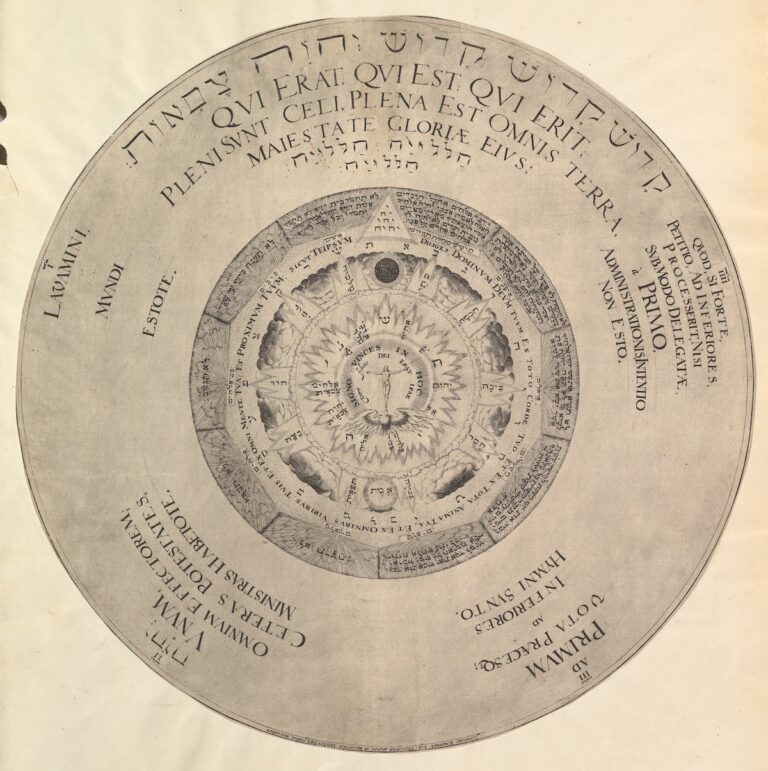
At the very heart of Kabbalah—Jewish mysticism—lies a concept so radical and profound that it reframes the nature of existence, the purpose of creation, and the origin of all human struggle. This is the concept of Tsimtsum (צִמְצוּם), often translated as "contraction," "withdrawal," or "concealment." Far from being an abstract theological idea, Tsimtsum is the foundational cosmic event that explains why there is a "dark side" to spirituality, why free will exists, and how the potential for both sublime good and unspeakable evil emerges from a God who is pure, infinite light.
The Problem of Infinity: Why Tsimtsum Was Necessary
To understand Tsimtsum, we must begin with the pre-creation state as described in Kabbalistic thought: Ein Sof (אין סוף)—the Infinite, Without End. This is not merely a powerful deity, but the seamless, absolute, and all-pervading reality of G-d's essence and infinite light (Ohr Ein Sof). In this state, there is no "other," no space, no independent consciousness. As the great Chassidic master, Rabbi Schneur Zalman of Liadi, illustrates: Imagine an infinitely brilliant teacher whose mind is in a state of total, rapturous expression. No student could possibly exist in that room, let alone learn. The student would be utterly overwhelmed, annihilated by the sheer force of that undiluted consciousness.
This is the primordial problem: How can a finite world, with independent creatures who feel separate and possess free will, come to exist within an infinite G-d? If G-d is "everything in all," there is literally no room for anything else. For creation to occur, a space for "otherness" had to be formed. This is the necessity of Tsimtsum.
The Act of Withdrawal: Creating a Vacated Space
The seminal 16th-century mystic, Rabbi Isaac Luria (the Ari), revealed the secret of Tsimtsum. He described it as G-d's primary creative act: not an expansion, but a contraction. G-d did not "go out" to create the universe; He "withdrew in" to make room for it.
- The Metaphor: Picture an endless, luminous ocean. At one "point," the water recedes, pulling back to create a hollow, empty sphere within the water itself. The water (the Infinite) still surrounds the sphere entirely, but inside the sphere, there is a conceptual absence of the water's immediate presence. This vacated space (Chalal HaPanui) is not devoid of G-d—for that is impossible—but is rather a space where G-d's infinite light is concealed and withheld.
- The Purpose of Concealment: This act of self-concealment was an act of profound love and purpose. It was the ultimate act of a "teacher" withholding His infinite brilliance to create the possibility for a "student"—creation—to exist, develop its own identity, and ultimately, choose to connect back to the teacher of its own volition. Tsimtsum is what makes relationship possible.
The Birth of Duality: From Singularity to "The Other Side"
With the creation of this conceptual vacuum, the stage was set for the drama of existence. Into this space, a thin, attenuated ray of divine light—the Kav (Line)—began to flow, carefully channeled and filtered through a complex system of vessels (Keilim) to construct the spiritual and physical worlds.
Here, the potential for darkness is born. The vessels, designed to contain and filter the light for the sake of creating structured, independent realms, were themselves a product of the initial concealment. They represented the principle of boundary, separation, and individuality. When the intense light of the Kav entered these vessels, a cosmic catastrophe occurred: the Shattering of the Vessels (Shevirat HaKeilim).
The vessels, incapable of withstanding the power of the unified light destined for a later stage, broke. Sparks of holiness fell, trapped within the shards of the broken vessels. These shattered vessels, now devoid of their intended holy purpose, became the raw material for kelipot (husks) and Sitra Achra (The "Other Side")—the kabbalistic terms for the spiritual roots of evil, darkness, and impurity.
This is the critical turning point:
- The Light (Sparks): Represents unity, selflessness, holiness, and connection.
- The Broken Vessels (Kelipot): Represent fragmentation, ego, selfishness, and separation.
Darkness, in the Kabbalistic view, is not a created force equal to light. It is a byproduct—the spiritual "waste" or "shadow" formed from the shattered instruments of concealment. It is the tangible reality of the absence of revealed light, filled with trapped, scattered sparks of holiness. The "Other Side" is precisely that: not an independent kingdom, but the other side of the coin of Tsimtsum—the necessary potential for separation that, when misused, becomes the realm of evil.
The Human Microcosm: Tsimtsum in Our Psyche and the "Dark Side of Spirituality"
This cosmic process is not just a creation myth; it is the blueprint of human consciousness. Each of us is a microcosm of this divine drama.
- The Inner Child (Pre-Tsimtsum State): We begin as infants in a state of pre-conscious unity—pure, seamless, and innocent. There is no duplicity, no hidden agenda, no sense of a separate self opposed to the world.
- The Conception of Ego (Personal Tsimtsum): As we develop, a process of psychological Tsimtsum occurs. To form a healthy ego—a necessary vessel for functioning in the world—we must learn boundaries, self-awareness, and distinction between "I" and "other." This is a holy concealment; it allows us to become independent individuals.
- The Shattering (Trauma & the Birth of the Shadow): Life inevitably brings pain, trauma, and injustice—our personal Shevirat HaKeilim. Our pure, trusting self is "shattered" by abuse, betrayal, or neglect. The healthy vessels of our ego crack. The pure light of our soul (our innocence, trust, love) becomes trapped and concealed beneath fragments of pain, forming our psychological shadow: our fears, insecurities, selfish desires, and destructive tendencies.
- Spiritual Corruption (Feeding the "Other Side"): This is where the "dark side of spirituality" emerges. When a person accesses profound spiritual energy—the deep, unifying light of the soul—but does so through the fractured lens of an unhealed ego (the kelipot), that power becomes corrupted.
- The Guru's Ego: The teacher who uses spiritual insight not for selfless elevation but for personal adoration, wealth, or sexual exploitation is channeling light through the broken vessel of narcissism.
- The Black Magician: The practitioner who uses mystical knowledge (the hidden laws of creation) to curse, control, or enrich themselves is attempting to harness sparks of holiness for the agenda of the Sitra Achra—the agenda of separation, selfishness, and dominance.
- The Abusive Mentor: The one who enters the holy-of-holies of another's vulnerable soul with impure intent is committing the ultimate abuse of Tsimtsum: using the space created for another's growth as a chamber for their own predation.
The Purpose and the Cure: From Fragmentation to Reintegration
The entire process, from Tsimtsum to Shattering, has one ultimate goal: Tikkun (תיקון)—Rectification or Mending.
- The Mission: Our life's work, both individually and cosmically, is to sift through the shards of our broken world and our broken selves, to liberate the trapped sparks of holiness. We do this by using every fragment—our challenges, our wounds, even our temptations—as a catalyst for conscious choice. We choose to act with kindness where selfishness is easier, with honesty where deception beckons, with selflessness where ego screams. Each such act "elevates a spark," repairing a vessel.
- The Role of Darkness: The Sitra Achra, the "dark side," therefore has a paradoxical purpose. It exists as the necessary contrast that makes free-willed choice meaningful. Without the possibility of true separation and selfishness (the kelipot), love, goodness, and connection would be automatic and devoid of merit. Darkness provides the resistance against which light defines itself and gains value.
- The Path to Wholeness: Healing and holiness come not from ignoring our shadow or our trauma (the kelipot), but from recognizing its origin. We must understand that our pain, our anger, our brokenness is not our core identity. It is the shattered vessel around a trapped spark of our divine soul. The cure is to reconnect with the pre-Tsimtsum innocence of our soul—the seamless unity with the Divine—and from that place of inner light, consciously redeem and transform the broken pieces. We don't worship our trauma; we heal it by revealing the light within it.
Conclusion: The Light Within the Darkness
The Kabbalistic doctrine of Tsimtsum offers the most profound answer to the problem of evil and the existence of a "dark side." It teaches that darkness is not an equal, opposing force, but a parasitic state of concealed light. The potential for black magic, spiritual abuse, and profound evil exists precisely because the spiritual energy is so real and so powerful—it is the very light of Ein Sof, filtered through the fractured prism of unrectified creation.
Therefore, the ultimate safeguard against the dark side of Kabbalah, or any spirituality, is intent rooted in selflessness (bittul)—the constant effort to reverse the contraction, to transcend the ego-vessel, and to act as a transparent channel for the unified light. It is a lifelong Tikkun: mending the vessels within and around us, transforming the very substance of the "Other Side" back into a vehicle for revelation, proving that even the deepest darkness is, in its secret core, a cry for the light it once contained.
Comments (Write a comment)
Showing comments related to this blog.