Methodologies in Focus: From Audio-Lingual Drills to Modern Communicative Approaches
Explore the evolution of language teaching methods. From the drill-based Audio-Lingual Method to modern communicative and task-based approaches, understand the theory and practice that shape today's classrooms.
Walk into a language classroom, and you are stepping into a living history of ideas. The methods a teacher uses—whether they prioritize drilling verb conjugations or facilitating a group debate—are the product of a century-long evolution in our understanding of how languages are learned. This journey from rigid, behaviorist audio-lingual drills to fluid, meaning-centered modern communicative approaches is more than academic trivia; it's the key to understanding why we teach the way we do today and how to choose the most effective path for learning.
For learners and educators alike, unpacking these core language teaching methodologies demystifies the classroom experience. It answers why some approaches feel mechanical while others unleash authentic expression. Let's trace this pivotal shift, moving from the strict repetition of the Audio-Lingual Method (ALM) to the dynamic, purpose-driven frameworks that define contemporary communicative language teaching.
The Age of Habit Formation: The Audio-Lingual Method (ALM) in Focus
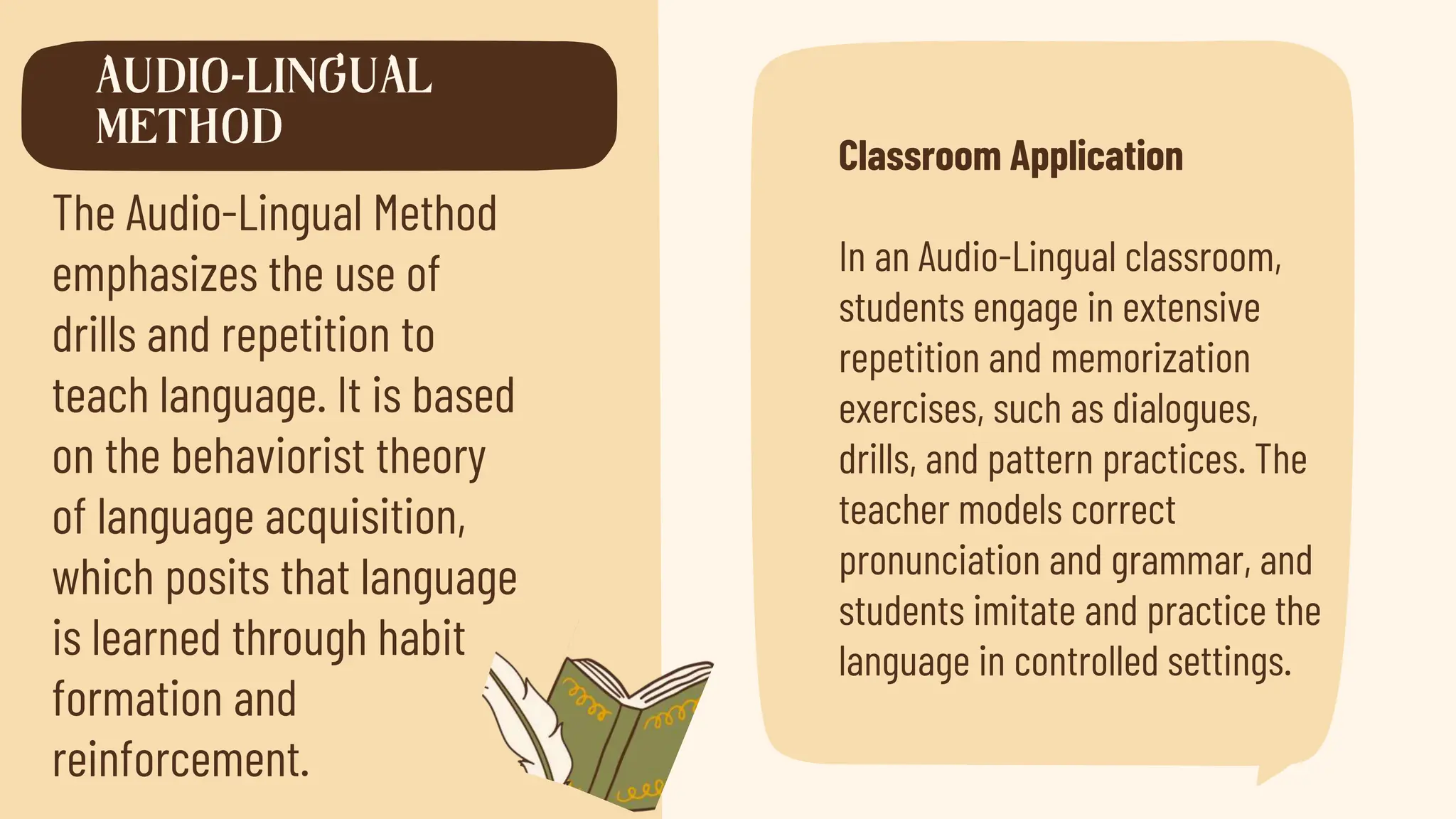
Born from the military's need for rapid language training during World War II and rooted in the behaviorist psychology of B.F. Skinner, the Audio-Lingual Method dominated mid-20th-century classrooms. Its core philosophy was simple: language is a set of habits. Learning is the process of forming these correct habits through repetitive conditioning and preventing errors, which were seen as the source of "bad" habits.
Hallmarks of the ALM Classroom (As Demonstrated by Diane Larsen-Freeman):
- Dialogue Memorization: Lessons began with students listening to and meticulously repeating a core dialogue, line by line.
- Repetitive Drilling: The teacher then led students through a battery of drills targeting structures from the dialogue:
- Repetition Drills: "I go to the store." "I go to the store."
- Substitution Drills: "I go to the store." → "I go to the bank." → "I go to the school."
- Backward Build-up Drill: For long sentences, teachers would start from the end ("the store") and build backward ("to the store" → "go to the store" → "I go to the store") to ensure flawless, automatic production.
- Minimal Grammar Explanation: Rules were induced from the patterns, not explicitly taught. The focus was on correct imitation, not intellectual understanding.
- Speech Before Writing: Reflecting the belief that speech is primary, students often didn't see written forms until a dialogue was fully memorized and drilled orally.
- Immediate Positive Reinforcement: "Good!" and "Very good!" were constant, reinforcing correct responses.
The ALM Legacy & Critique:
ALM was revolutionary in its emphasis on listening and speaking. However, its critical flaw became apparent: students drilled to perfection in class often couldn't communicate in real-world, unpredictable situations. They had mastered habits, not language as a creative, meaningful system. This gap between classroom performance and communicative competence sparked a paradigm shift.
The Communicative Revolution: A Focus on Meaning and Function
In the 1970s and 80s, the Communicative Language Teaching (CLT) approach emerged as a direct response to ALM's limitations. CLT shifted the goal from "linguistic competence" (knowing the rules) to "communicative competence"—the ability to use language appropriately in real social contexts to achieve a purpose.
Core Principles of Modern Communicative Approaches:
- Meaning is Paramount: The primary goal of any activity is successful communication of a message. Accuracy is secondary to being understood.
- Context is King: Language is not learned in abstract vacuum. It is tied to specific social situations, roles, and functions (e.g., apologizing, inviting, complaining).
- Authentic Materials: Real-world texts—menus, news articles, advertisements, podcasts—replace contrived textbook dialogues.
- Learner-Centered, Interactive Activities: The classroom buzzes with pair work, role-plays, simulations, and information-gap tasks where students must negotiate meaning to solve a problem. The teacher is a facilitator, not a drill sergeant.
- Tolerating Errors: Errors are seen as a natural byproduct of developing interlanguage, not a habit to be eradicated at all costs. Fluency and risk-taking are encouraged.
Task-Based Language Teaching (TBLT): The Communicative Ideal Realized
Task-Based Language Teaching can be seen as the purest incarnation of the communicative philosophy. As detailed by Rod Ellis, it places a pedagogic "task"—an activity with a clear outcome that requires learners to focus on meaning—at the very center of the curriculum.
How TBLT Differs from ALM & Traditional CLT:
Unlike ALM drills, a task has a communicative gap (information or opinion) and requires learners to use their own language resources. Unlike some CLT activities that might still practice a pre-selected "function of the day," a true TBLT lesson starts with the task attempt. Language instruction ("focus on form") comes afterward, based on the errors and needs students displayed while trying to communicate. This ensures language work is directly relevant and driven by genuine communicative need.
A Comparative Snapshot: The Methodology Evolution
Feature | Audio-Lingual Method (ALM) | Traditional CLT | Task-Based Teaching (TBLT) |
Primary Goal | Form correct linguistic habits. | Develop communicative competence. | Complete a meaningful task; language is a tool. |
Focus | On form and accuracy. | On meaning and function. | On outcome; form is addressed post-task. |
Teacher Role | Orchestrator & Model. Directs drills, corrects errors. | Facilitator. Sets up communicative activities. | Coordinator & Advisor. Prepares tasks, advises on language after attempts. |
Student Role | Imitator & Pattern-Practicer. | Negotiator & Communicator. | Problem-Solver & Language User. |
Error View | To be prevented (source of bad habits). | Tolerated as part of learning. | Natural; basis for post-task "focus on form." |
Material Core | Contrived dialogues and drills. | Authentic materials and situational activities. | Pedagogic tasks with real-world relevance. |
Implications for Today's Learners and Teachers
Understanding this evolution empowers you to evaluate your own learning or teaching context:
- If your class feels heavy on drills... you're experiencing the enduring influence of ALM. Complement it with self-directed communicative practice: find a language partner, use AI for conversation, or engage with authentic media.
- If your goal is real-world fluency... seek out or create opportunities aligned with modern communicative approaches. Prioritize activities with a purpose—booking a mock hotel, debating an issue, summarizing a news clip—over decontextualized grammar exercises.
- The Balanced, Informed Approach: The history of language teaching methodologies isn't about discarding the old for the new. It's about informed synthesis. Elements of ALM (like pattern recognition) have value for mastering tricky verb conjugations. The communicative drive of CLT and TBLT is essential for developing usable fluency. The most effective modern instruction often blends a focus on form with abundant opportunities for a focus on meaning.
The shift from audio-lingual drills to communicative approaches represents a fundamental reorientation: from viewing language as a static habit to understanding it as a dynamic tool for human interaction. For the learner, this means seeking not just practice, but purpose. For the teacher, it means designing not just lessons, but experiences. By understanding the "why" behind these methods, we can all make more conscious, effective choices on the path to language mastery.
Comments (Write a comment)
Showing comments related to this blog.