When a Language Dies, an Ecosystem Forgets: Ganesh Devy on the People’s Linguistic Survey
Introduction: The Silent Extinction
In the 1961 Census of India, 1,652 mother tongues were recorded. By 1971, that number had plummeted to 108. Almost 1,544 languages vanished from official record in a single decade. This statistical massacre was not the result of a biological catastrophe—it was an administrative and political erasure. For Professor Ganesh Devy, this staggering data gap was not just an error; it was a symptom of a civilizational crisis.
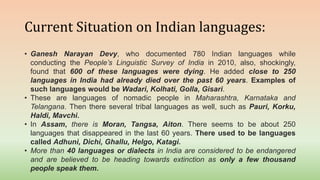
This post delves into Devy’s monumental response—the People’s Linguistic Survey of India (PLSI), a citizen-led movement involving over 3,000 volunteers, which ultimately documented 780 living languages in India, nearly 200 of which are critically endangered. But the PLSI is more than a linguistic catalogue. It reveals a profound truth: when a language dies, an entire ecosystem of knowledge, memory, and relationship forgets itself.
The Spark: From Census Data to a People’s Movement
Devy’s journey into linguistic activism began with a paradox. The dramatic drop in language counts between the 1961 and 1971 censuses was politically motivated—post the 1971 Bangladesh War, the government was wary of highlighting linguistic diversity. The methodology was flawed: only languages with over 10,000 speakers were counted, and distinct mother tongues were forcibly “clubbed” under major language headings (like Bhojpuri under Hindi).
“All others—which are those other languages?” Devy asked. This question became his life’s mission.
When a government plan for a national language survey collapsed due to bureaucratic turf wars between the Home and Education Ministries, Devy took it upon himself. Leveraging his academic networks and decades of work with tribal and nomadic communities, he mobilized a people’s army of volunteers—teachers, activists, writers, and community elders—to document what the state had rendered invisible.
Key Findings: The PLSI’s Revolutionary Discoveries
The PLSI uncovered a linguistic India far richer and more fragile than anyone had imagined.
1. The Coastal Catastrophe:
Devy found that the fastest-disappearing languages belong to coastal and island communities. This wasn’t due to a lack of grammar books, but to a deliberate policy of displacing traditional livelihoods. When the government leased coastal rights to corporate deep-sea fishing conglomerates, small-scale fishing communities were devastated. The Kharwa community of Gujarat, once numbering in the hundreds of thousands and holding massive annual gatherings, has now scattered. Their language, tied intrinsically to seafaring, net-making, and tidal knowledge, is dying with their way of life.
Insight: Language loss is directly tied to livelihood destruction. When people are displaced from their ecological niche, their language cannot survive.
2. The Silent World of Indian Sign Languages:
One of the most stunning discoveries was that India has 8–9 distinct, full-fledged Indian Sign Languages (ISL), developed and transmitted intergenerationally within Deaf communities. For sign language users, their signs are their mother tongue; the written languages they learn in school are second languages. This reframes everything about education and inclusion for the Deaf in India.
3. Secret Languages and Denotified Tribes:
Devy documented how denotified tribes (formerly branded “criminal tribes” by the British in 1871), facing constant suspicion, developed secret languages or codes for internal communication. In extreme cases, like the Gondhali community, language moved beyond words entirely into a complex system of signs and gestures so efficient that a Gondhali could transmit a whispered French sentence across a crowded room without error.
Insight: Language can become a tool of social survival and resistance in the face of persecution.
4. The Northeast: A Biodiversity-Linguistic Diversity Hotspot:
The PLSI confirmed India’s Northeast as having the highest per capita density of languages in the world. Here, the link between ecological and linguistic diversity is undeniable. For example, the survey found 16 languages in Himachal Pradesh that together have over 200 words for snow—each describing specific conditions (e.g., snow under moonlight, snowflakes on water). This isn’t poetry; it’s precision ecological knowledge encoded in vocabulary.
5. The Language of a Single Speaker:
Perhaps the most poignant finding was of a language with only one remaining speaker, an elderly woman who, until her death around 2010, used her language only to speak to birds. With her passing, a unique way of perceiving and interacting with the avian world vanished forever.
The Core Philosophy: Language as a Bridge, Not a Tool
Devy’s work transcends linguistics. He posits a grand philosophical theory:
- Consciousness (our inner world) and the Phenomenal World (external reality) are both complex and uncertain.
- The only certain bridge between them is Language.
- Language is the system by which we name the world, construct our self, and connect the two.
Therefore, when a language dies:
- A unique bridge between a community’s consciousness and their world collapses.
- A way of knowing, classifying, and relating to reality is lost.
- This is not just a “cultural loss”; it is a cognitive and ecological extinction.
“Words are a transport system… they carry a quantum of meaning. When that system stops running, the meaning it carried for generations is stranded, then forgotten.”
The Threat: Migration and the Unraveling of the “Language Knot”
Devy identifies the primary engine of language death: migration. Humans naturally form “language knots”—communities of about 800-1,000 people among whom a unique language emerges and stabilizes.
“The moment you unravel that population knot… their language starts going down.”
Today, 36% of the world’s population is migrant, driven by economic need, conflict, or climate disaster. This global unraveling is causing a parallel mass extinction of languages. Climate change will accelerate this, creating “climate refugees” whose displacement severs their linguistic roots twice over: first from their land, then from the knowledge system that land sustained.
The Way Forward: Linguistic Justice and the Defense of the Small
Devy’s mission is not about preserving languages in museums. It is about linguistic justice—the right of every speech community to exist, thrive, and define itself.
- Link Language Rights to Livelihood Rights: Policies must protect the economic ecosystems that sustain language communities (e.g., rights of small fishers, forest dwellers).
- Decentralize Language Data: The state’s homogenizing census must be challenged by people’s own documentation of their speech.
- Value the Minimum, Not Just the Maximum: The PLSI was an act of making the invisible visible—vouching for “languages with minimum speakers,” defending every dialect.
- See Diversity as Evolutionary Strength: “Diversity of language is important for continuing our environmental diversity of species… Diversity allows the evolutionary process to go forward.”
Conclusion: The Ethical Imperative of Listening
The People’s Linguistic Survey of India is more than a scholarly achievement; it is a moral compass. In an age hurtling toward digital homogenization and cognitive silences, it reminds us that every language is a unique recipe for being human.
When the last speaker of a language dies, we don’t just lose words. We lose:
- A classification system for plants and animals.
- A philosophy of time, space, and relationship.
- A history woven into ballads and idioms.
- A way of laughing, grieving, and dreaming.
Ganesh Devy’s work is a call to listen—to the whispers of the last speakers, to the signs of the Deaf, to the secret codes of the oppressed, to the snow-word vocabularies of the mountains. It is a call to recognize that in safeguarding the smallest language, we protect a vital strand in the web of human intelligence and ecological wisdom. We defend the right of multiple worlds to exist, and in doing so, we ensure our own future remains imaginatively rich, resilient, and truly alive.
“Diversity will take us forward… attack in any manner on diversity will slow us down and make us come to a standstill. There is no point in marching forward to a standstill. No point in going ahead to the past.”
The fight for linguistic diversity, therefore, is the fight for a future worth having.
Comments (Write a comment)
Showing comments related to this blog.