Sigils, Circles, and Summons: A Guide to Solomonic & Diabolic Magic
An In-Depth Exploration of Ritual Power and Demonic Pacts
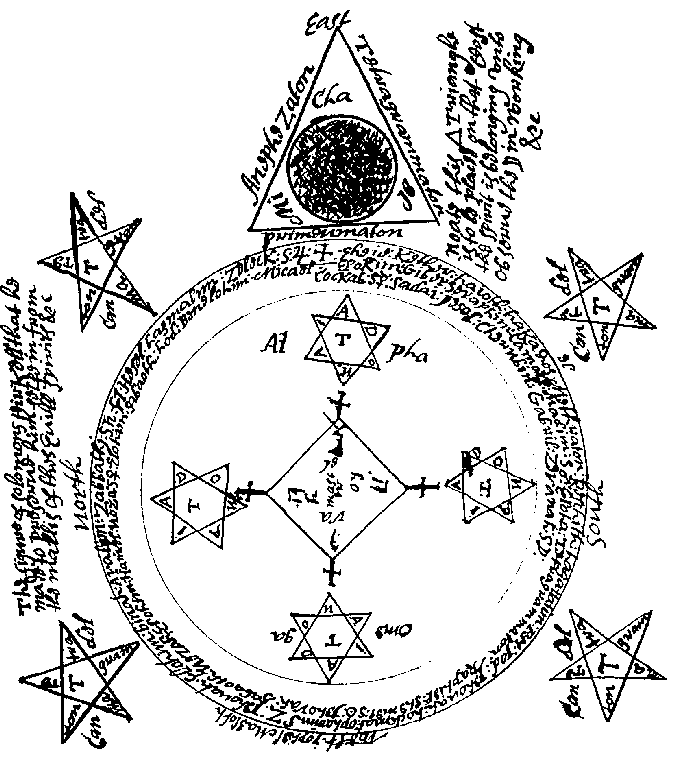
Introduction: Two Paths to the Infernal
In the popular imagination, summoning a demon is a singular act of depravity: a blood-soaked ritual in a candlelit basement, ending in possession or death. This caricature obscures a far more nuanced and historically rich reality. Within Western occultism, there are two fundamentally distinct methodologies for interacting with demons, born from opposing philosophies and goals: Solomonic Magic and Diabolic Witchcraft.
One seeks to command demons as a slave-master, the other to worship them as a devotee. One invokes the name of God to bind, the other renounces God to serve. Understanding this schism is key to navigating the labyrinth of grimoires, sigils, and rituals that define ceremonial magic.
Part I: Solomonic Magic – The Art of Divine Command
Core Philosophy: The practitioner, acting as an agent of God’s divine authority, compels a demon to appear and obey. The demon is a prisoner, forced into service. This is not demon worship; it is spiritual domination through sacred power.
The Foundational Mythos: The Legend of King Solomon
The entire tradition rests on the legend of King Solomon, the wise biblical king. Apocryphal texts like the Testament of Solomon (1st-3rd century CE) recount how the Archangel Michael gave Solomon a magical ring engraved with the Seal of God (a pentagram). With this ring, Solomon bound demons, interrogated them about their natures, and forced them to build his Temple.
This established the template:
- Divine Authorization: Power flows from God, not the magician's own might.
- The Power of the Name and Seal: Knowing a demon’s true name and unique sigil grants control.
- Demons as Reluctant Laborers: They can be compelled to reveal secrets, teach arts, and perform physical tasks.
The Grimoires: Blueprints for Control
Solomonic magic is a science of exactitude, documented in detailed textbooks called grimoires.
- The Key of Solomon (Clavicula Salomonis): The foundational text (14th-15th cent.). It focuses on the preparation of the magician—moral purity, fasting, prayers, baths—and the consecration of tools (wand, sword, knife, incense). It stresses that the ritual will fail if the operator is sinful or impure.
- The Lesser Key of Solomon (Lemegeton): The most famous practical manual (17th cent.). Its most important section is the Ars Goetia, which lists 72 demons with their ranks, legions, powers, and, crucially, their sigils.
- The Arbatel of Magic: A more "white" Solomonic text emphasizing cooperation with celestial spirits, but within the same framework of divine authority.
The Ritual Architecture: A Fortress of Sanctity
A Solomonic ritual is an exhausting, days-long operation of spiritual fortification.
1. Preparation of the Magician (The Operator):
- Purification: A multi-day fast, abstinence, confession of sins, frequent prayer.
- Astrological Timing: Operations must align with specific planetary days and hours (e.g., Mars for war, Mercury for knowledge).
- Vestments: The wearing of sanctified, virgin-white linen robes.
2. Preparation of the Space: The Magic Circle
This is not just a drawing; it is a spiritual fortress. Constructed with meticulous care, it includes:
- Divine Names: Names of God (Tetragrammaton, Adonai, Elohim) written around the perimeter.
- Archangelic Names: Michael, Gabriel, Raphael, Uriel at the cardinal points.
- Geometric Symbols: Triangles, hexagrams, and crosses forming layers of defense.
- The circle protects the magician. To step outside it during the summoning is to invite disaster.
3. The Tools of Authority:
- The Magic Sword or Knife (Athame): Used to command spirits and threaten disobedience.
- The Wand: A conduit for the magician’s will and divine power.
- The Pentacle of Solomon: A disc or medal, often of wax or metal, bearing protective symbols, worn or held.
- The Brass Vessel: From the legend of Solomon trapping demons in a brass jar; sometimes used symbolically.
4. The Summoning Itself:
- The Conjuration: A lengthy, formal address. It does not ask the demon to appear; it commands it in the name of God. Example: "I conjure and command thee, O Spirit [Name], by the living God, by the true God, by the holy God… that thou appear forthwith in this triangle, to do my will in all things!"
- The Triangle of Art: Placed outside the circle, this is where the demon is forced to manifest. Its confinement within the triangle further neutralizes its power.
- The Seal (Sigil): The unique, geometric "signature" of the demon. It is drawn on parchment, often placed within the triangle. The demon is compelled to appear when its sigil is properly invoked. Holding its seal gives the magician authority over it.
5. The License to Depart:
Crucially, the ritual does not end with the demon’s obedience. The magician must formally dismiss it with a "license to depart," commanding it to leave peacefully and without causing harm. Failure to do so leaves a dangerous entity loose.
Purpose of Solomonic Magic: To gain knowledge (of sciences, hidden treasure), love, protection, or to harm enemies—but always from a position of divinely-sanctioned control.
Part II: Diabolic Witchcraft – The Pact of Subservience
Core Philosophy: The practitioner voluntarily submits to a demon (often Satan) through a pact, offering worship, service, or their soul in exchange for power, pleasure, or knowledge. Here, the power dynamic is inverted: the demon is the master.
The Sources: Inquisitorial Fears & Folk Reality
Our knowledge of diabolic witchcraft is heavily filtered through the lens of its persecutors—texts like the Malleus Maleficarum (The Hammer of Witches, 1487) and King James I’s Daemonologie (1597). These sources are propaganda, designed to prove the existence of a Satanic conspiracy. Yet, they describe a coherent, if likely exaggerated, folk tradition.
The Demonic Pact: The Heart of the Relationship
The pact could be explicit or implicit.
- The Explicit Pact: A literal contract signed in blood, often recounted in trial confessions under torture. The witch promises their soul, regular worship, or the sacrifice of an unbaptized infant. The demon promises earthly power, wealth, or sensual pleasure.
- The Implicit Pact: Simply engaging in witchcraft using demonic aid was seen by the Church as an implicit pact with the Devil.
The Witches' Sabbath: The Infernal Congregation
The central gathering of diabolic witchcraft, as described by inquisitors, was a grotesque inversion of Christian mass:
- Location: A remote crossroads, forest clearing, or mountaintop.
- The Devil's Presence: Satan would appear in a hideous form (often as a man with goat-like features) seated on a throne.
- Homage: Witches would kiss the Devil's anus (osculum infame), renounce Christ and baptism, and trample the cross.
- The Black Mass: A blasphemous parody of the Eucharist, sometimes involving the sacrifice of a child or the use of foul substances.
- Orgy: A communal sexual act to dissolve social and familial bonds, sealing their allegiance to the new infernal "family."
- Feast: A meal of disgusting or tasteless food.
- Familiars: Minor demons in animal form (cats, toads, dogs) given to the witch to act as servants, spies, and conduits for magic. They were fed the witch’s blood from a "witch's mark."
- Incubi/Succubi: Demons who engage in sexual intercourse with the witch. This was seen as both a form of temptation and a method of sealing the pact. The succubus would collect male seed to then transform into an incubus and impregnate a woman, theoretically breeding more witches or demons.
The Goal & The Price
The goal was not disciplined command, but the fulfillment of base desires: revenge, lust, material gain, or simply the thrill of transgressive power. The price, as told by the Church, was eternal damnation. The witch’s power was entirely dependent on the demon's continued favor.
Part III: The Great Divide – A Comparative Analysis
Aspect | Solomonic Magic | Diabolic Witchcraft |
Source of Power | God’s authority, invoked through holy names, seals, and ritual purity. | The demon itself, accessed through submission, pact, and sacrilege. |
Relationship to Demon | Master-Slave. The magician commands with holy threats. | Servant-Master. The witch worships and petitions. |
Ritual Foundation | Sanctity & Order. Fasting, prayer, consecration, complex geometry. | Profanity & Transgression. Blasphemy, inversion of Christian rites, breaking of taboos. |
Primary Texts | Grimoires (Key of Solomon, Lemegeton). Technical manuals. | Inquisitorial Treatises (Malleus Maleficarum). Descriptive accusations. |
Practitioner’s Stance | The righteous exorcist, the wise king, the holy warrior. | The heretic, the apostate, the rebel against divine order. |
Ultimate Goal | To use infernal forces to achieve a worldly or intellectual end while maintaining spiritual safety. | To gain power, pleasure, or revenge through alliance with the infernal, often at the cost of the soul. |
View of the Divine | Central. The entire operation affirms God’s supreme power. | Rejected or inverted. The operation is based on rebellion against it. |
The Grey Area: Grimorium Verum & Theurgy
Some grimoires, like the Grimorium Verum, blend the two. They use Solomonic structures (circles, seals, divine names) but include blood sacrifices and darker elements, leaning toward a transactional rather than a commanding relationship. Furthermore, texts like the Ars Theurgia Goetia (part of the Lemegeton) deal with "aerial spirits" of mixed nature—neither wholly good nor evil—requiring a more nuanced, diplomatic approach.
Conclusion: The Mirror of Ambition
Solomonic and Diabolic magic represent two sides of humanity's desire to harness the forbidden. They are a profound mirror:
- Solomonic Magic reflects the ambition to dominate chaos through order, to force the irrational universe to bend to human will and divine law. It is the path of the scholar, the ascetic, and the theological risk-taker.
- Diabolic Witchcraft reflects the ambition to gain power through transgression, to seize what is denied by authority by allying with the very thing that authority fears. It is the path of the rebel, the outcast, and the desperate.
One seeks to chain the demon with holy geometry; the other seeks to wear its collar. Both paths acknowledge the terrifying reality of these forces, but they offer radically different answers to the oldest question of power: Do you seek to command the darkness, or do you invite it in?
Comments (Write a comment)
Showing comments related to this blog.